The sky's own theatre
From September to April the aurora dances over Lofoten – above peaks, shorelines and rorbu rooftops. With a base in the middle of the islands you don't need an organised "aurora hunt": you simply drive to where the sky is clearest, in minutes.
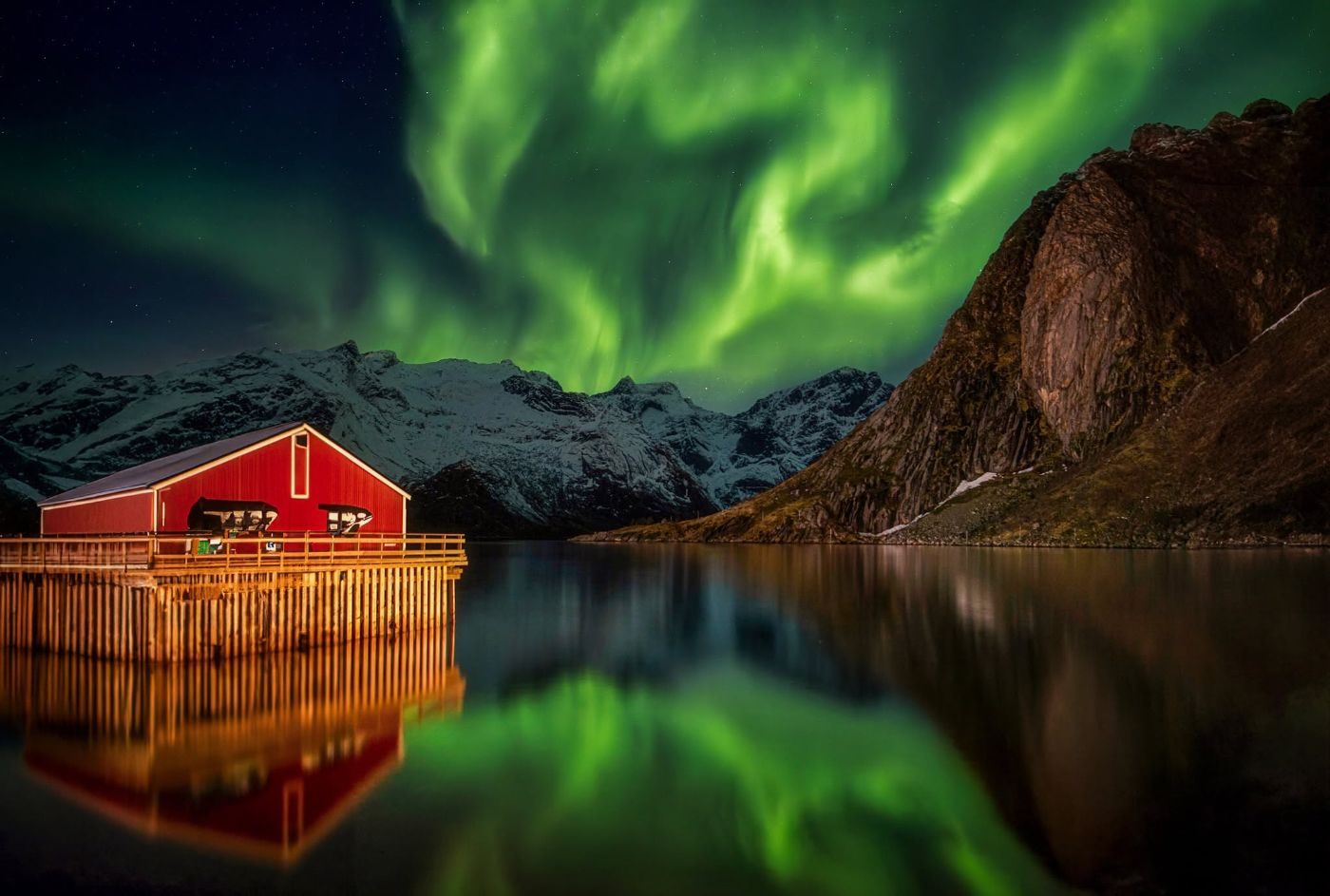
When can you see the northern lights?
The aurora season in Lofoten runs from September to April – all it takes is a dark, clear sky. From around the autumn equinox it's dark enough from early evening, and activity often peaks late in the evening, typically between 22:00 and 23:00. But the lights can appear any time after dark and vanish just as fast: the single best tip is simply to look up, often.
Why Lofoten is a particularly good place
Here's the point most aurora apps won't tell you: Lofoten lies directly beneath the auroral oval itself – the belt around the poles where the northern lights are born. Many apps lean heavily on the KP index, which measures how far south the lights can be seen. In Lofoten it's all but irrelevant: even on quiet nights with a low KP, the sky can erupt right above you. What you actually need to check is the cloud cover.
- Check the cloud forecast on Yr for the spots around the base – the weather is local, and it's often clear in one place and overcast in another.
- Be patient and mobile. With a car and short distances in every direction you can move to where it's clear – that's the whole advantage of staying in the middle of Lofoten.
- Use an alert app as backup if you like, but never let an app overrule what you can see with your own eyes.
The best spots near the base
The rule is simple: away from street lights, ideally facing open sea to the north. All of these are within about half an hour of the chalet:
- Haukland and Uttakleiv (approx. 15–20 min) – north-facing beaches framed by mountains. Uttakleiv ranks among Norway's finest aurora locations.
- Vik (approx. 15 min) – the same sky as Haukland, fewer people.
- Eggum (approx. 25 min) – open ocean to the north, minimal light pollution.
- Skagsanden (approx. 35 min) – the wet sand mirrors the lights and doubles the show; a classic among photographers.
Photo tips
A simple setup goes a long way: tripod, wide-angle lens, and a starting point of around ISO 2000, aperture f/2.8–f/4 and 2–6 seconds' exposure – adjust to how active the lights are. Newer phones with night mode also do surprisingly well, as long as they're held steady. And the most important tip of all: put the camera down now and then, and just watch.